We're a Turkish manufacturer, so we're not neutral — but we can be honest. Vietnam and Turkey are genuinely different manufacturing environments. The choice between them depends on product type, price point and what you're optimizing for. For some US brands, Vietnam is the right answer. For others, Turkey is. This comparison gives you the data to make that call.

Flat-knit knitwear manufacturing — Turkey vs Vietnam comparison for US buyers
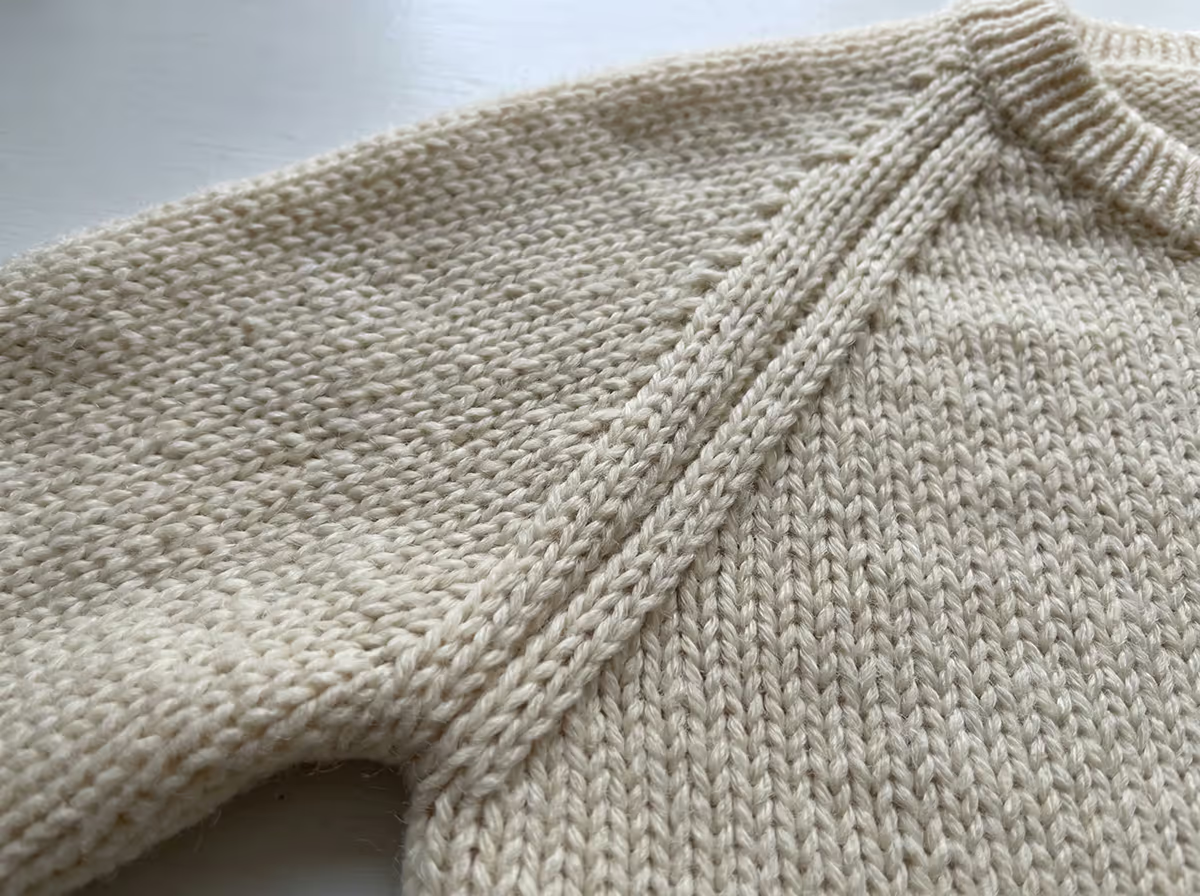
Flat-knit panel shaping: where Turkey's manufacturing depth shows most clearly

Side-by-Side: The Key Factors

FactorVietnamTurkey
US import duty (knitwear, MFN)~16–32 % (HTS 61xx)~16–32 % (same MFN)
Section 301 China tariffsNot affectedNot affected
Flat-knit sweater depthLimited — jersey/cut-sew dominantDeep (Shima Seiki, Stoll)
WHOLEGARMENT capabilityRareYes
MOQ (flat-knit sweater)500–2,000 pcs typical250 pcs
Ocean transit → US East Coast~28–35 days~14 days
Ocean transit → US West Coast~18–22 days~25–30 days
Unit cost: cotton jersey basicsLowerHigher
Unit cost: fine flat-knit / merinoComparable or higherMid

The Tariff Question — Clarified

A common misconception: Vietnam is not duty-free for the US. The US did not ratify the TPP/CPTPP, so Vietnam has no preferential tariff agreement with the US. Both Turkey and Vietnam pay the same MFN (Most Favored Nation) rates on knitwear — roughly 16–32 % depending on the HTS code. Neither country has a tariff advantage over the other for US imports.

Vietnam's advantage in the "China exit" conversation is different: it's an alternative to Chinese production that avoids Section 301 tariffs. But those 301 tariffs are on Chinese-origin goods. If you're already sourcing outside China — whether from Vietnam or Turkey — both are equally clear of 301 exposure.

Where Vietnam Wins

01

High-volume cotton jersey and knit basics

Vietnam's garment industry is built around jersey cut-sew: T-shirts, polos, hoodies, activewear. If your knitwear program is cut-and-sew jersey at volume — 5,000+ units — Vietnam factories are well-tooled and price-competitive for that product type.

02

West Coast-oriented supply chains

If your DC or 3PL is in LA, Seattle or the Bay Area, Vietnam's ~18–22 day West Coast transit is a genuine advantage over Turkey's ~25–30 day route to the same ports. East Coast brands don't benefit from this.

03

Large-scale activewear and performance knit

Performance jersey — moisture-wicking, compression, stretch fabrics — is a Vietnamese strength. If your product overlaps more with athletic wear than with traditional sweaters, that's a signal to look at Vietnam.

Where Turkey Wins

01

Flat-knit sweaters: the core difference

Vietnam's flat-knit sector is thin. Factories with Shima Seiki or Stoll CMS machines capable of full-gauge, intarsia, jacquard or WHOLEGARMENT production are uncommon. Turkey's Aegean and Anatolian textile clusters — including Gaziantep — have deep flat-knit depth across the gauge range.

02

Low minimums for sweater programs

A 250 MOQ per style/color is realistic for flat-knit in Turkey. In Vietnam, sweater-specific factories capable of quality flat-knit typically require 500–2,000 pcs to justify machine setup. For brands building small collections or testing a new sweater category, Turkey is more accessible.

03

East Coast supply chains and speed

~14 days Mersin to Savannah/NY/NJ is a real advantage. For brands doing two or more drops per year where timing matters — or where a fast reorder window is important — Turkey's shorter East Coast lane tightens the production-to-shelf window significantly.

04

WHOLEGARMENT and premium positioning

If your brand needs seamless knitting technology, fine merino or cashmere-blend production, or European-grade quality documentation (OEKO-TEX, audit-ready paperwork), Turkey is the more natural fit. Vietnam's strengths don't extend deeply into this segment.

The Practical Decision Framework

Choose Vietnam if: your sweater program is primarily cut-sew jersey at high volume, your DC is West Coast, and unit cost on basics is the primary driver.

Choose Turkey if: you need flat-knit construction (not cut-sew jersey), want WHOLEGARMENT, are working with 250–1,500 pcs MOQ, source to East Coast, or need fine-gauge merino/cashmere-blend capability.

Consider both if: your line includes a mix of jersey basics (Vietnam) and premium flat-knit styles (Turkey). A dual-source approach is increasingly common for US brands managing supply chain concentration risk.

Decision Framework: Four Questions Before You Choose

These four questions cut through most of the noise. Work through them in order — your answers will point to the right country faster than any general comparison.

Q1

What construction do you actually need?

Jersey, cut-sew, woven, activewear fabric — Vietnam. Flat-knit panel construction, full-fashioned, intarsia, jacquard, WHOLEGARMENT — Turkey. This single question resolves the decision for most brands. If your tech pack says "cut panels from knit fabric," that's jersey. If it says "knitted to shape on a flat-knit machine," that's flat-knit. They are made in different factories, with different equipment, in different countries.

Q2

Where is your distribution center — West Coast or East Coast?

A US West Coast DC (LA, Seattle, Bay Area) gives Vietnam a genuine transit advantage: roughly 18–22 days ocean vs Turkey's 25–30 days to the same ports. An East Coast or Midwest DC reverses this: Turkey runs ~14 days to Savannah, NY/NJ, or Baltimore vs Vietnam's 28–35 days to the same ports. If you're split between both coasts, the transit argument neutralizes itself and product fit becomes the deciding factor.

Q3

What fiber and gauge are you working in?

Cotton and polyester jersey basics — Vietnam's strength. Fine-gauge merino, cashmere-blend, mohair, or mid-gauge flat-knit (7gg to 14gg) — Turkey's depth. Vietnam's sweater factories, where they exist at all, cluster around coarser gauges and more basic yarns. Turkey has broad gauge range from 3gg chunky through 16gg fine-gauge, plus established supply chains for premium European yarns and specialty fibers.

Q4

Do you have UFLPA supply chain exposure?

The Uyghur Forced Labor Prevention Act (UFLPA) applies to goods with inputs traceable to Xinjiang. Both Vietnam and Turkey carry risk if their yarn suppliers source cotton from Xinjiang-linked mills — the country of final manufacture doesn't shield the goods from scrutiny. If your program is building away from Xinjiang-origin cotton, ask suppliers in either country for documented yarn provenance, not just a certificate of origin for the finished garment.
Common Misconceptions — Corrected

A few assumptions circulate persistently in sourcing conversations about Vietnam and Turkey. Here's where the record needs straightening.

01

"Vietnam is duty-free into the US"

False. The US did not ratify the TPP or CPTPP. Vietnam has no preferential tariff agreement with the US, and knitwear from Vietnam enters at the same MFN rates as Turkey — roughly 16–32 % depending on the HTS code. The confusion stems from Vietnam's role as a China tariff alternative: it avoids Section 301 duties, but those apply only to Chinese-origin goods. Once you're already sourcing outside China, both Turkey and Vietnam are equally clear of 301 exposure. Neither has a tariff edge over the other for US buyers.

02

"Turkey is only for luxury — Vietnam handles the basics"

Partly true, but oversimplified. Turkey's flat-knit capability runs from budget cotton styles through premium cashmere, not luxury only. A mid-gauge cotton acrylic blend crewneck at an accessible price point is a normal Turkey flat-knit project. Vietnam's cut-sew strength is in jersey, wovens, and activewear — not flat-knit sweaters specifically. The real split is construction type, not price tier. A luxury boutique buying fine merino flat-knit and a value brand buying cotton acrylic flat-knit might both land in Turkey — for the same reason.

03

"Vietnam's lead time is shorter"

Depends entirely on where your goods are going. Vietnam air freight to the West Coast is fast — and for that lane, Vietnam ocean freight is also competitive. But ocean transit from Vietnam to the US East Coast runs 28–35 days. Turkey to the East Coast runs ~14 days. For brands doing tight seasonal windows into East Coast DCs, Turkey's transit advantage can be meaningful: it compresses the production-to-shelf calendar by two to three weeks. Vietnam's speed advantage is real, but it's geography-specific, not universal.

Who Is Each Country Actually Right For?

Both countries are capable suppliers. The question is fit — and the honest answer depends on your product, not your preference.

VN

Vietnam fits your program when...

  • Your sweater program is primarily jersey cut-sew at 5,000+ units per style
  • Your DC is West Coast and ocean transit time is a real constraint
  • You're moving activewear, performance knit, or woven-adjacent categories alongside knitwear
  • Unit cost on cotton or polyester basics is the primary sourcing driver
  • Your factory is already in Vietnam for other categories and adding sweaters to an existing relationship
TR

Turkey fits your program when...

  • You need flat-knit construction — full-fashioned, intarsia, jacquard, or WHOLEGARMENT
  • Your collection runs 250–1,500 pcs per style and Vietnam's MOQ floors are too high
  • Your DC is East Coast or Midwest and a 14-day ocean lane matters for your calendar
  • You're working in fine-gauge merino, cashmere-blend, or specialty yarn that needs an established premium fiber supply chain
  • You want OEKO-TEX documentation, audit-ready paperwork, or European compliance standards as a baseline

Sourcing Comparison

Turkey vs China — Full Comparison

See how Turkey's position compares across all major knitwear sourcing alternatives.

See full comparison →

Evaluating Turkey for your flat-knit program?

Send us your style references or tech pack. We'll give you a realistic quote and honest feedback on whether Turkey is the right fit — or where it isn't.

Related Guides

→ Bangladesh vs Turkey Sweater Manufacturing → India vs Turkey Knitwear OEM → China+1 for US Sweater Brands
WhatsApp