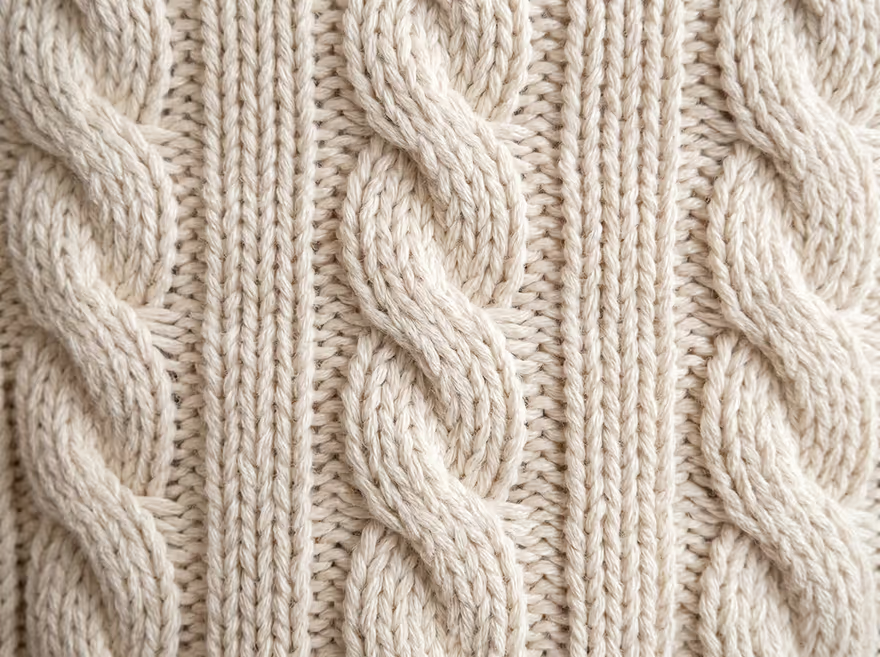
Cable knit creates the characteristic rope or braid texture by periodically crossing groups of stitches over each other — a process called needle transfer. Every time the cable twists, the machine lifts a group of stitches off their needles and re-places them in reversed position before the next row knits through. The more stitches involved and the more frequently this happens, the more machine time it requires. Understanding this is the key to understanding cable pricing: it's not just the yarn or the gauge — it's the mechanical complexity of the stitch structure that determines CMT.

Cable knit construction — Kiwi Giyim flat-knit manufacturing
12-gauge cable pattern produced on Shima Seiki flat-knit machine, Gaziantep

Cable Types and What They Require

01

Simple 4-Stitch Cable

The most basic cable: 4 stitches that cross every 4–8 rows, creating a clean vertical rope. Machine produces the crossing by transferring 2 stitches to the back needle bed, knitting the remaining 2 forward, then returning the 2 transferred stitches. Requires one transfer cycle per cable cross. This is the entry-level cable for production pricing — efficient, clean, universally recognizable. A sweater with 4–6 simple rope cables in a panel is a moderate CMT increase over plain knit, not a major one.

02

Honeycomb Stitch

Honeycomb (also called seed cable or basketweave cable) creates a dense, textured all-over surface by alternating cable crosses across the panel in a staggered grid. It is typically a 2-over-2 or 4-stitch cross repeating at regular intervals across the full panel width, offset every repeat. The visual result is a rich, tactile surface. Machine time is higher than simple rope cable because the transfers occur across the entire panel, not just in vertical cable columns. Very popular for accessories and sweater bodies where the texture is the design.

03

Aran (Multi-Cable Combination)

Aran knitwear — named for the Aran Islands' traditional pattern tradition — combines multiple cable types in a single panel: central diamond cable, flanking rope cables, seed stitch ground, bobbles, and more. Programming an aran pattern for a flat-knit machine requires defining every stitch transfer across multiple cable panels simultaneously, with different cross frequencies. Production speed is significantly slower than simpler cables. Aran is the most expensive cable knit construction in CMT terms. The result is justifiably the most premium-looking — and it has substantial heritage appeal in the US market. If you are specifying aran, budget for the CMT premium and build it into your retail price.

04

Fisherman's Rib and Twisted Stitch

Fisherman's rib (also called brioche rib) creates a thick, deeply ribbed fabric by working each stitch together with its slipped-stitch partner from the previous row. The result is a squishy, full-bodied fabric that looks like a double-rib but has a different structural feel. Twisted stitch (knitting through the back loop) creates a tighter, more defined stitch with slight horizontal texture. Both are executed by the machine through modified needle selection and stitch manipulation rather than literal needle transfer. These are less CMT-intensive than cable crossing but add character and warmth to the fabric.
Fiber Choice for Cable Stitch Definition

Not all fibers show cable stitch structure equally well. Wool and merino are the best fibers for cable definition — the natural crimp of wool holds the stitch shape clearly after steaming, making the cable ridges stand out cleanly. Cotton has less memory and elasticity than wool; cables in cotton are readable but flatter and less dimensional. Acrylic blend can work for value-price cable knit — the synthetic fiber holds some shape — but is less defined than wool. Cashmere makes beautiful cable knit at fine gauge but is soft and slippery enough that stitch definition is slightly less sharp than wool — this is a deliberate trade-off (you get cashmere softness plus cable texture). Silky fibers (modal, viscose blends) generally give poor cable definition because the fiber's low memory allows stitches to relax and lose their shape. Avoid silk-heavy yarns for cable knit unless the goal is a very subtle, relaxed cable texture.

The US Market for Cable Knit

Cable knit sweaters are a consistent bestseller in the US market across every retail price point — from $45 basics at accessible retail to $380 fisherman's knit at premium specialty. The category has proven durability because cable knit reads as "craft" and "quality" to US consumers even in its simplest form. This makes it a safe category for brands building their first knitwear program: a well-executed simple cable crewneck at 7gg merino blend is a commercially reliable product with broad consumer appeal. The complexity choice — simple cable vs aran — should be made based on your target retail price and the CMT premium you can absorb, not on aesthetic ambition alone. A simple cable executed perfectly is more commercially successful than a complex aran executed at a CMT that doesn't support the retail price.

Have a cable knit concept for your collection?

Send us your reference or sketch and target retail price. We'll quote the CMT based on your actual cable complexity — simple rope through full aran — and advise on the fiber that will give the best result.

Related Guides

→ Chunky Knit Sweater Manufacturing for US Brands → Cardigan Manufacturing for US Private Label Brands → Private Label Crewneck Sweater Manufacturing for US Brands
WhatsApp