MOQ — minimum order quantity — is one of the most common points of confusion when US brands first approach an overseas knitwear factory. The number itself varies by factory and by country, but the reason it exists is the same everywhere: flat-knit production has real setup costs that don't scale to very small runs. Understanding why the minimum exists helps you plan your buy intelligently, rather than trying to negotiate the factory below a floor that has costs behind it.

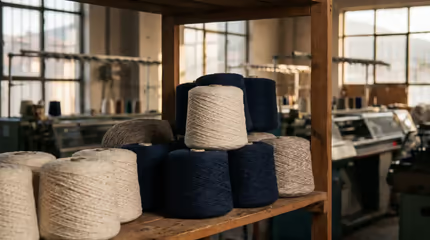
Flat-knit knitwear production detail — Kiwi Giyim, Gaziantep Turkey
Flat-knit knitwear detail: precision construction from Turkish manufacturer for international fashion brands

Why Flat-Knit Factories Have Minimums

01

Machine Programming

Every style on a flat-knit machine requires programming — the stitch pattern, shaping instructions and construction logic are entered into the machine's software. This takes skilled time (typically 1–4 hours per style depending on complexity) whether you're making 50 units or 500. Below a certain quantity, the setup cost per unit makes the style financially impractical to produce.

02

Yarn Minimum

Yarn is typically ordered in minimums from the mill — often 10–25 kg per color. For a fine-gauge merino sweater, 10 kg might yield 60–80 garments. If you want a custom yarn color (dye to match), the minimum order from the dye house is usually higher still. Below the yarn minimum, the cost per unit for the material alone becomes prohibitive.

03

Quality Control Overhead

Inline and final quality inspection has a baseline overhead regardless of quantity. The first garment out of bulk needs to be checked against the approved sample the same way as the hundredth. QC time doesn't compress linearly with very small runs.

04

Export and Documentation

Costing, commercial invoice, packing list, certificate of origin, export declaration — these are per-shipment processes, not per-unit. They have the same cost for 100 units as for 500. Small runs absorb these costs at a proportionally higher per-unit rate.

How 250 Pieces Works in Practice

250 pieces per style-color means: for each unique combination of style and color, the minimum production run is 250 garments. Here's what that looks like for a typical order:

For startup or boutique brands placing a first order, the common approach is to go narrower on styles and colors — maybe 2 styles × 1 color = 500 units — rather than spreading 250 units across many SKUs. This keeps the total investment manageable and gives you clean data on what sells before you expand the range.

Turkey vs China on MOQ: The Honest Picture

A common assumption is that Chinese factories have lower minimums than Turkish ones. In practice, for flat-knit sweaters specifically, this isn't consistently true. Chinese flat-knit factories targeting export markets often quote 500–1,000 pieces per style-color as their effective minimum — the setup economics are the same. Where Chinese factories genuinely have lower MOQs is in the cut-and-sew jersey category (T-shirts, hoodies) where production setup is simpler. For structured flat-knit sweaters at comparable quality levels, Turkey's 250-piece MOQ is actually competitive with what you'll find from quality-focused flat-knit factories in China. The meaningful difference is quality tier, lead time and compliance documentation — not MOQ.

What We Can't Do (and Won't Pretend We Can)

We're a factory, not a sample house. We can produce proto samples and salesman samples for development purposes — that's a normal part of the production process. But we can't produce 50-piece runs for retail or ongoing orders below 250 pieces per style-color at a price point that makes sense for either party. If your total order is fewer than 250 units across all styles and colors, a factory relationship isn't the right fit — you'd be looking at a local knitter, a made-to-order small-batch studio, or dropship alternatives. That's an honest answer, not a negotiating position.

Frequently Asked Questions

What is the minimum order quantity for knitwear from a Turkish factory?

At Kiwi Giyim, the minimum is 250 pieces per style-color combination. This floor exists because flat-knit production has real fixed setup costs — machine programming, yarn minimum pull, QC overhead, export documentation — that don't compress economically for very small runs.

Can I split 250 pieces across multiple sizes?

Yes. The 250-piece minimum applies per style-color unit — the size distribution within that run is yours to set. A typical first-order ratio might be 40 XS / 80 S / 80 M / 50 L. Different colors within the same style can have different size ratios if you need to weight certain sizes differently.

Does China have lower minimums than Turkey for flat-knit sweaters?

Not consistently. Chinese flat-knit factories targeting export markets at comparable quality levels often require 500–1,000 pieces per style-color. The assumption that China always has lower MOQs is accurate for cut-and-sew jersey, not for specialized flat-knit knitwear. Turkey's 250-piece MOQ is actually competitive within the flat-knit category.

Can I order a production run of fewer than 250 pieces for retail?

No. Proto samples and salesman samples are produced during development as a normal part of the process, but these are not retail units. Production orders below 250 pieces per style-color are not viable at factory pricing. If your total volume is below 250 pieces, a small-batch studio or made-to-order producer is a more appropriate fit.

What is a realistic first order for a startup knitwear brand?

A common first-order approach is 2 styles × 1 color each = 500 units total. This keeps capital exposure manageable, generates clean sell-through data per SKU, and positions you to expand the range the following season based on what actually sold. Going wide on styles and narrow on depth per style is usually the wrong call for a first production order.
OEM Manufacturing

Kiwi Giyim — OEM Knitwear Manufacturer

250 pcs per style/color is our real minimum — no upsell, no surprise volume requirement.

See OEM services →

Planning a 250-Piece First Order?

We can walk you through what a first-order buy plan looks like in practice — styles, colors, sizes, pricing and timeline. Send us a brief or a tech pack and let's make it concrete.

Related Guides

→ Private Label Sweater Manufacturing for US Brands → DTC Knitwear Brand Manufacturing in Turkey → Knitwear Manufacturing for US Fashion Startups: What's Actually Possible
WhatsApp