Private label means your design, your label, your brand — manufactured to your spec by an OEM factory. Here's exactly how that process works, from the first tech pack to the carton arriving at your warehouse.
Private label knitwear manufacturing is simpler in principle than most brands expect: you provide the design specification, the factory produces it under your brand. No factory name on the garment, no factory branding — just your label, your hangtag, your product. The complexity is in the execution: getting from a design idea to a tech pack, running the sampling process correctly, and managing the quality handoff between approved sample and bulk production. This guide walks through each stage.
A tech pack is the single most important document in private label manufacturing. It should include: construction type (flat-knit, gauge, WHOLEGARMENT or cut-and-sew), yarn specification (fiber content, count, ply, supplier reference if known), detailed measurements with graded sizes, stitch pattern details, color references (Pantone or yarn dye lot), and finishing details (seaming, trim, hardware).
You'll need your brand label (woven or printed), care label (with fiber content and country of origin — this is a US legal requirement under FTC rules), and hangtag artwork. These are usually supplied by you as print-ready files; the factory sources the physical labels and attaches them.
A confirmed quantity per style-color and a size ratio (e.g., 50 XS / 100 S / 100 M / 50 L per color) is needed before a factory can give you a final price. Price per unit changes with quantity — give a realistic figure, not your best-case scenario.
Give the factory a target FOB price range. This allows them to tell you quickly if your target is achievable in their cost structure. Withholding the target price rarely helps — it usually results in a quote that misses your range and wastes both sides' time.
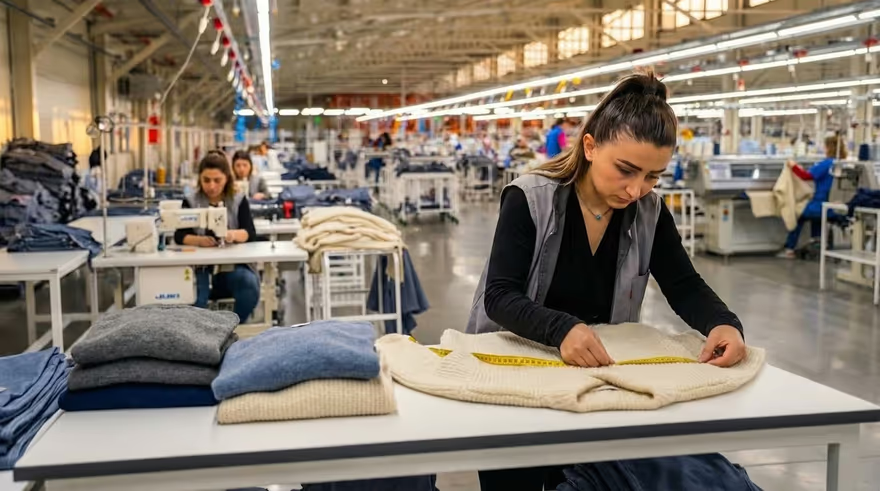
A typical private label knitwear project from tech pack submission to bulk shipment runs 12–18 weeks. Here's what happens in each phase:
For US market, the following are legally required on every garment under FTC regulations:
Turkish manufacturers are experienced with US label requirements. Provide your label specs in advance; the factory will confirm compliance before production.
From a private label perspective, Turkey's flat-knit manufacturing ecosystem has specific advantages for US brands: the MOQ is low enough (250 pieces) to make a private label capsule viable at mid-size brand scale; the sampling process is fast enough (~4–5 weeks proto to approval) to fit a seasonal calendar; and the documentation chain — EU-grade quality systems, fiber content certification, non-Xinjiang cotton — supports the compliance and transparency requirements that US retailers and DTC brands increasingly mandate. The honest caveat: Turkey is not the cheapest option for commodity-grade basics. Its lane is design-led, quality-forward knitwear where the per-unit cost can be justified by quality, compliance and lead time.
How private label knitwear works on Amazon — FNSKU, bundling, listing requirements, and MOQ considerations for FBA sellers.
Production options, gauge choices, and pricing for private label crewneck sweaters — the most common starting product for new knitwear brands.
Cardigan-specific construction details — button plackets, shaping, gauge choices — and what to include in a cardigan tech pack.
The full picture on OEM knitwear from Turkey: machines, gauge range, techniques, certifications, MOQ and lead times.
Private Label Service
Your brand, your labels, your packaging — we handle production and you own the product.
See private label service →Send us your tech pack or a product brief with your target quantity and price range. We'll come back with a costing, a sample timeline and any questions about your spec — within one business day.