Section 301 is the China-specific tariff layer that rewrote sweater economics for US brands. Here's what it is — and what it isn't.
Section 301 is a US trade tool that lets the government impose extra tariffs on goods from a specific country in response to trade practices. In practice, for apparel brands it means one thing: many China-made products carry an additional duty on top of the normal tariff — a cost layer that goods from other countries simply don't have.
For years the China sourcing case rested on the lowest unit price. Section 301 added a China-specific surcharge that narrows or erases that gap for a lot of knitwear — before you even count lead time, MOQ or compliance. When you stack the 2026 baseline tariff (which most origins pay) plus Section 301 (which only China pays), China's total landed duty can run meaningfully above an alternative origin's.
Section 301 coverage and rates depend on the specific tariff classification of your product. Don't assume — have your customs broker confirm what applies to your styles today.
Unit price + base duty + Section 301 + freight + compliance overhead. Once you total it, a slightly higher ex-works price from a non-China supplier often lands lower.
Section 301 lists and 2026's baseline measures have changed repeatedly. Build your costing so a rate change doesn't blow up a season — that's the case for a second supplier.
Section 301 doesn't make non-China sourcing "free." Turkey, like most origins, pays the base apparel duty and the 2026 baseline tariff — we're not duty-free. What we don't carry is the China-specific 301 layer or the UFLPA cotton-detention risk. That's the advantage: not zero duty, but a lower and more predictable total. Confirm specifics with a licensed customs broker.
Section 301 tariffs are additional US duties imposed on Chinese-origin goods. For apparel, they add a China-specific surcharge on top of the normal base import tariff. They apply only to goods manufactured in China — not to Turkey, Portugal, Bangladesh, or other origins.
No. Section 301 is China-specific. Turkish knitwear pays US base import duties (MFN rates, typically around 16–17% for cotton and wool sweaters) but is not subject to the Section 301 surcharge.
The additional amount depends on the specific HTS code. China-origin knitwear has faced additional Section 301 duties ranging from 7.5% to 25% beyond the base rate under various List actions. Confirm current applicable rates with a licensed customs broker, as the lists and rates have changed over time.
No. There is no US-Turkey free trade agreement. Turkish knitwear pays the standard MFN base tariff — approximately 16–17% for cotton and wool sweaters. The advantage over China is the absence of the Section 301 surcharge, not zero duty.
Not necessarily. Section 301 narrows China's cost advantage but does not eliminate it for all products at all volumes. The right decision depends on your HTS code, volume, UFLPA compliance exposure, and total landed cost model including freight and lead time. Most experienced brands treat it as one factor among several.
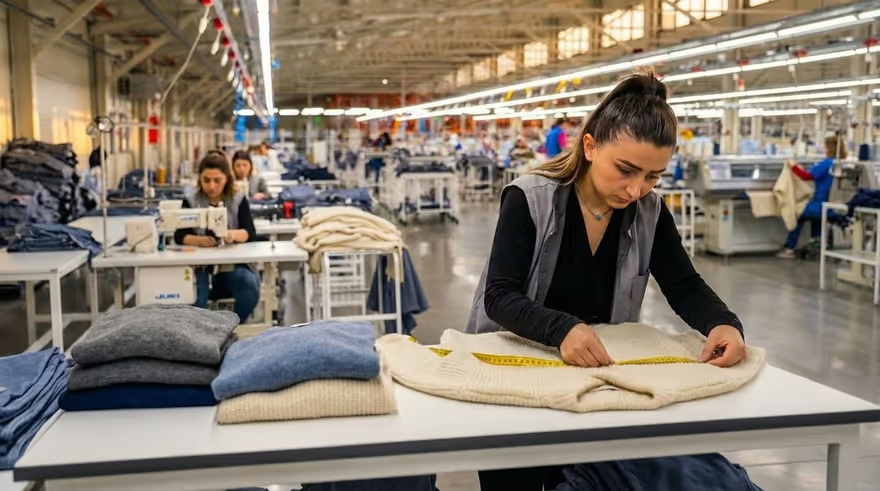
Honest side-by-side comparison on cost, compliance, speed and quality — with updated 2026 data on Section 301 impacts.
The documentation US importers need to clear UFLPA enforcement — and how Turkey's supply chain simplifies the process.
Turkish knitwear enters the US at 0% duty under most HTS 6110 headings — here's exactly which code your garment falls under.
Sourcing Comparison
See how the full tariff picture affects landed cost when sourcing from Turkey vs China.
See full comparison →Send your styles. We'll quote ex-works so you can drop our number into your landed-cost model alongside the 301 math.