One continuous piece, no seams, no sewing. The technology is real — and so are its constraints. Here's what buyers need to understand before specifying it.
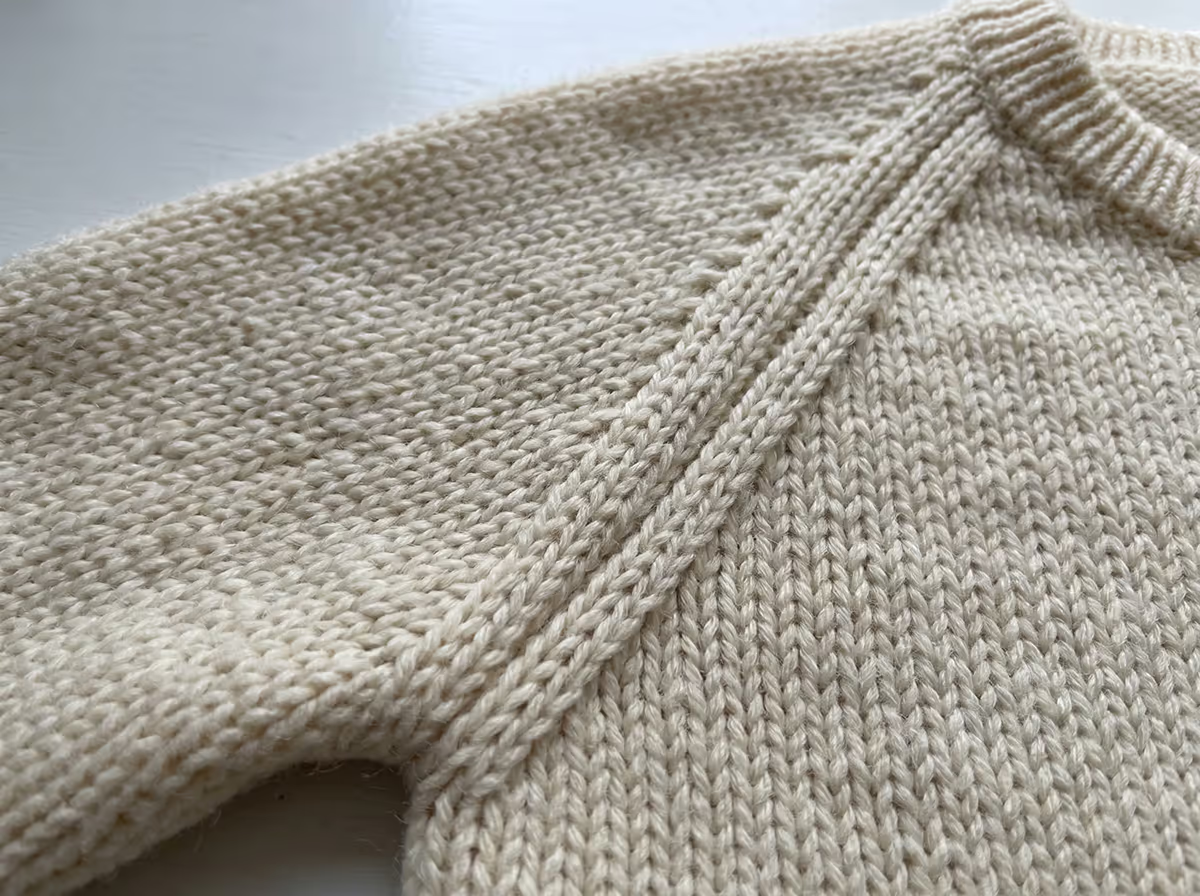
WHOLEGARMENT is Shima Seiki's 3D knitting technology: the machine knits the entire garment — body, sleeves and all — in a single continuous operation, off the machine as a complete, finished piece. There are no side seams, shoulder seams or sleeve seams. No linking, no sewing to close the body. The construction method is genuinely different from anything in conventional knitwear.
No seams means no friction points against the skin. For next-to-skin wear — base layers, fitted sweaters, layering pieces — this is a meaningful functional difference. "No side seam" is not marketing language; it's a physical fact that customers can feel.
An uninterrupted knit surface drapes differently than a seamed garment — it flows and moves as a single piece. For premium and contemporary brands, that quality reads clearly in photography, in the hand and on the body.
WHOLEGARMENT uses exactly the yarn the garment requires. There are no cut panels, no edge yarn loss, no offcuts. For brands building a sustainability narrative, this is a documentable, verifiable claim — not a stretch.
WHOLEGARMENT allows stitch structures to change across the garment in three dimensions — different textures on the body vs sleeves, integrated pocket structures, gradient color effects — that are difficult or impossible to achieve with conventional flat-knit panel construction.
WHOLEGARMENT is not a superior version of regular knitwear that every brand should default to. It has real constraints. Production speed: a WHOLEGARMENT piece takes more machine time per unit than equivalent fully-fashioned production — slower throughput means higher CMT cost. Design constraints: not every construction can be achieved in a single 3D knit; structured collars, certain set-in sleeve shapes and some tailored details are difficult or require workarounds. Machine specialization: WHOLEGARMENT requires Shima Seiki's specific machine platform and trained operators — it is not universally available across knitwear factories. We run it in-house, but your other suppliers may not.
Specify WHOLEGARMENT when: the garment is next-to-skin (seam comfort matters), the brand story includes sustainability (near-zero waste is a real talking point), the design is premium and the higher CMT cost is justified by the retail price, or the design specifically benefits from 3D construction. Specify conventional fully-fashioned flat-knit when: the style is more structured (blazer shapes, set-in sleeves), the volume is large and unit cost pressure is real, or the design is a standard construction where WHOLEGARMENT adds cost without adding meaningful value. We'll tell you which direction makes sense for your specific piece — even if it means recommending the less specialized option.
Why US premium and contemporary brands are adopting WHOLEGARMENT — cost-per-unit reality, sustainability positioning, and MOQ considerations.
The structural difference between knit-to-shape and cut-and-sew, and how to choose the right construction for your product and price point.
Our Shima Seiki WHOLEGARMENT capability: machines, available gauges, MOQ from 250 pieces, and what zero-seam production looks like in practice.
22 dedicated flat-knit machines, gauge range 3–14gg, all techniques available — the complete production picture behind our WHOLEGARMENT programs.
Manufacturing Service
Our Shima Seiki WHOLEGARMENT machines produce seamless pieces in one pass — from 250 pcs MOQ.
See WHOLEGARMENT capabilities →Share the design brief or tech pack. We'll give you an honest recommendation on WHOLEGARMENT vs fully-fashioned and quote both where it's useful.