When your factory asks for a yarn count and you're not sure what to write, the wrong answer causes the wrong fabric. This guide explains the counting systems, ply notation, and what belongs in your tech pack.
Yarn count is a measure of how fine or coarse a yarn is. The higher the count number (in most systems), the finer the yarn. There are two main count systems used in knitwear manufacturing — metric (Nm) and English cotton (Ne) — and they use opposite logic, which is the source of much confusion for brand buyers. Getting yarn count right in your tech pack is not optional: the wrong count spec produces the wrong gauge, the wrong weight, and the wrong fabric hand.
Nm (Nummer metrisch) is the most common count system in European and Turkish knitwear manufacturing. It measures the number of meters of yarn per gram of fiber. Nm 28 means 28 meters of yarn per gram. A higher Nm number = a finer, lighter yarn. A lower Nm number = a coarser, heavier yarn. Nm 10 is thick; Nm 60 is very fine. This is the count system you will encounter on yarn data sheets from Turkish and European spinners. Most Gaziantep factories communicate yarn in Nm notation.
Ne (English/cotton count) is common in the US and UK, originally developed for cotton spinning. It measures the number of 840-yard hanks per pound of fiber. Ne 30/1 means 30 hanks per pound. Higher Ne = finer yarn — the same directional logic as Nm. Conversion between systems: Ne × 1.693 ≈ Nm. So Ne 16/1 ≈ Nm 27. This close-enough conversion is useful for checking whether a supplier's yarn is in the ballpark of your spec. If you receive a yarn data sheet in Ne and your factory uses Nm, convert before specifying. Mismatched systems are a common source of the wrong yarn being ordered.
Ply refers to the number of single yarns twisted together to form the final yarn. 2/28 Nm means: 2 plies, each ply with a count of Nm 28. When plied together, the resulting yarn has a metric count of approximately Nm 14 (half of 28, because two strands together are twice as thick). 2/48 Nm = finer 2-ply (each strand Nm 48, resulting yarn ~Nm 24). 3/28 Nm = 3 strands of Nm 28 twisted together, resulting yarn ~Nm 9.3 — a much thicker result. Ply also affects twist structure: two Z-twist singles plied with S-twist create a balanced yarn. This matters for how the fabric behaves on the needle and in use.
Twist direction (S or Z) affects fabric hand and stitch appearance. S-twist singles and Z-twist singles both produce functional yarns, but when knitted, they bias slightly differently — affecting surface smoothness and stitch lean. For most knitwear applications the twist direction is set by the spinner and you do not need to specify it unless you are re-producing an existing style and need to match the hand exactly. If you are working from a physical reference sample and the factory is producing from scratch, request a twist-matched yarn sample before approving the bulk yarn. Mismatched twist can produce a fabric that measures correctly but does not feel the same.
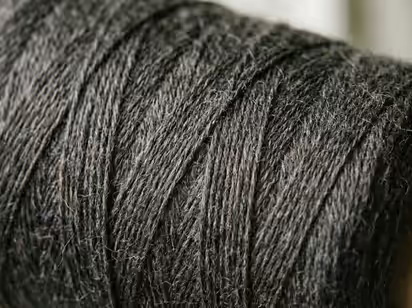
For flat-knit machines, yarn count and gauge are closely related. Approximate reference points: 1/3.5 Nm → 3gg super chunky; 1/5–1/7 Nm → 5gg chunky; 2/16–2/28 Nm → 7gg midweight; 2/28–2/36 Nm → 10gg lightweight; 2/48 Nm → 12gg fine gauge; 2/60–2/72 Nm → 14–16gg ultra-fine. These are approximate — the actual tension setting on the machine matters as well. A factory running 2/28 Nm yarn tighter on the same machine will produce a different fabric hand than one running it looser. This is why your tech pack must specify both yarn count and target gauge — not just one or the other.
Nm (Numero Metrico) is the metric count system used by Turkish and European yarn suppliers. It measures the number of meters of yarn per gram. Nm 28 = 28 meters per gram. Higher Nm = finer yarn. Nm 14 is thick/chunky; Nm 60 is very fine. This is the standard count notation you will see on yarn data sheets from Turkish factories.
2/28 Nm means a two-ply yarn where each ply has a count of Nm 28. When twisted together, the resulting yarn has an effective count of approximately Nm 14 — half of 28, because two strands together are twice as thick. It's a common spec for 7gg to 10gg midweight knitwear in merino or wool blends.
Both measure fineness: Nm is metric (meters per gram, used in Turkey/Europe); Ne is English cotton count (840-yard hanks per pound, common in the US and UK). To convert: Ne × 1.693 ≈ Nm. A yarn specified as Ne 16/1 is approximately Nm 27. Always specify which system you're using in your tech pack to prevent misunderstandings with Turkish factories, which use Nm.
Yes — count and gauge are closely paired. Approximate reference: 2/28 Nm → 7–10gg; 2/48 Nm → 12gg; 2/72 Nm → 14–16gg. If your tech pack specifies a gauge and a yarn count that don't match, the sample will produce the wrong fabric weight and hand. Always specify both gauge and yarn count explicitly in your tech pack.
Yes. "Nm 28 merino" without ply is ambiguous — it could mean 1-ply Nm 28 (single strand) or 2-ply Nm 28 (two strands twisted together), producing dramatically different yarn thickness and resulting fabric weight. Always write the full specification: "2/28 Nm merino" or "1/14 Nm wool blend" to be completely unambiguous with your factory.
We review tech packs as part of our quoting process and flag missing or ambiguous yarn specs before they cause sampling problems. Request a quote and send your tech pack — we'll return with questions before we return with a price.