Amazon FBA has specific packaging, labeling, and documentation requirements that differ from wholesale or DTC fulfillment. Here's how to set up your Turkish knitwear production to land correctly at an Amazon FC.
Amazon FBA is an attractive channel for private label sweaters — search-driven discovery, Prime fulfillment, and scalable inventory management. But sourcing knitwear for FBA from Turkey requires more upfront planning than sourcing for DTC or wholesale. The packaging requirements are specific, the lead time gap between Amazon's reorder signals and Turkish production timelines needs active management, and UFLPA cotton traceability is increasingly relevant for apparel on Amazon. This article covers each of these practically.
Amazon requires that poly bags with an opening of 5 inches or larger carry a suffocation warning printed or affixed to the outside. The required text and minimum font size are specified in Amazon's Seller Central packaging guidelines. Have your factory print this directly on the poly bag — not on an insert inside it — before production ships.
Each unit must have an FNSKU barcode label that is scannable. For sweaters, the standard placement is on the poly bag exterior, or on the hangtag if the hangtag is visible through transparent packaging. Confirm label placement with your prep center or factory before final production — placement errors are a common cause of FC receiving delays.
Amazon prefers case packs with a uniform quantity per case and a single ASIN per carton. Confirm case quantity, carton dimensions, and gross weight with your freight forwarder early — Amazon FCs have specific carton size limits and heavy-carton surcharges. Turkish factories can pack to your spec, but this needs to be in the purchase order, not requested at the last step.
Some Turkish factories can apply FNSKU labels, bag, and case-pack to your spec before shipping. Others ship to a US third-party prep center for FBA prep. Both work — the factory option saves time and handling cost if the factory can do it reliably. Ask for a sample prep run before committing to factory-level FBA prep for your full order.
Amazon increasingly requests supply chain documentation for apparel, and UFLPA (Uyghur Forced Labor Prevention Act) compliance is becoming a baseline expectation for US apparel sellers — not just an enterprise-brand concern. The UFLPA creates a rebuttable presumption that goods produced wholly or in part in Xinjiang, China are made with forced labor. To import and sell on Amazon without risk of CBP holds, you need to be able to document your cotton supply chain.
Turkish knitwear factories can source non-Xinjiang cotton and provide supply chain documentation: yarn supplier declaration, cotton origin certificates, and transaction records. This is not automatic — you need to specify it in your purchase order and confirm the yarn supplier before production begins. Turkish OEM producers with US-brand experience are familiar with this requirement. Ask for it explicitly and get the documentation in writing before your goods ship.
The core tension for Amazon FBA sellers sourcing from Turkey: Amazon's inventory management system triggers reorder signals when stock reaches a threshold — often with 2–4 weeks of lead time expectation built into the algorithm's planning. Turkish production requires 8–12 weeks from order confirmation to goods at your US door (4–6 weeks production + 2–3 weeks ocean + customs clearance). These timelines do not align without active inventory planning.
The solution is safety stock and forward ordering. Rather than reordering reactively when Amazon's inventory health dashboard shows a warning, successful FBA sellers using Turkish factories order 3–4 months ahead of projected sell-through. This requires forecasting, which is uncomfortable for sellers used to fast-turn domestic or air-freight sourcing — but it is not optional at Turkish production timelines. Build a 60–90 day safety stock buffer into your inventory plan for your first season.
For the launch phase specifically: if you're launching a new ASIN, order your initial inventory before you have sales velocity data. 250 units is the minimum production run from most Turkish flat-knit factories — which translates to 1–2 ASINs at a test quantity. Launch with this, generate reviews and ranking data, then place your replenishment order early in the sales cycle rather than waiting for inventory to deplete.
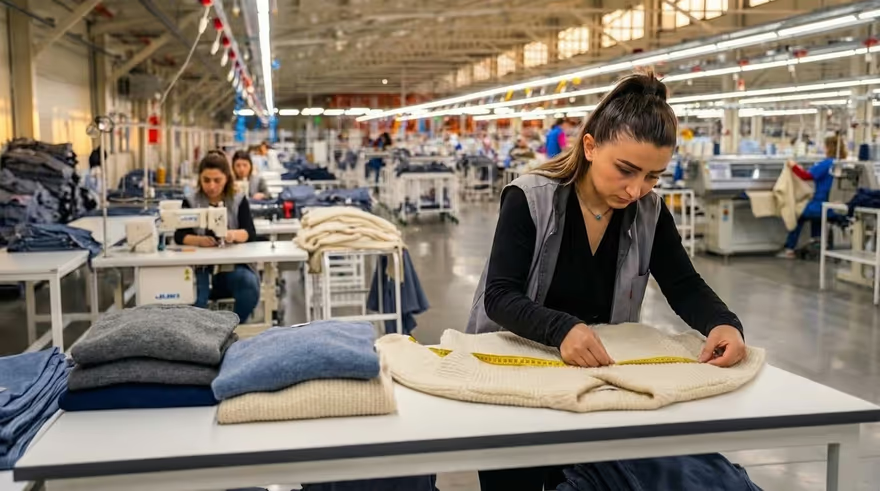
Full overview of private label knitwear from Turkey — MOQ, sampling, lead times, labeling and how the process works from brief to delivery.
Supply chain documentation and traceability requirements for selling knitwear on Amazon without UFLPA enforcement risk.
Fiber content disclosure, care instructions, country of origin marking — FTC requirements for Amazon private label knitwear listings.
Our machines, gauge range, certifications and MOQ — the production basics for Amazon FBA private label knitwear programs.
Private Label Service
FBA-compliant labeling, poly-bagging and carton marking included in full-package quotes.
See private label service →We produce private label flat-knit and WHOLEGARMENT sweaters for Amazon FBA sellers from 250 units. We can provide UFLPA-compatible supply chain documentation and pack to FBA spec. Send us your design brief or tech pack and we'll give you a realistic production timeline and FOB quote.