Cashmere is not grown in Turkey. That's a fact worth stating plainly: the raw fiber comes from cashmere goats in Mongolia and Inner Mongolia, spun into yarn in Italy, Scotland or China, and then imported by Turkish knitting factories. What Turkey contributes is the flat-knit machinery, skilled operators, finishing infrastructure and the EU-calibrated quality systems that consistently produce cashmere knitwear at a standard European luxury brands rely on. For a US brand sourcing cashmere OEM at 250 pieces per colorway, this combination — traceable fiber into a high-grade flat-knit operation — is the practical path to a viable product.

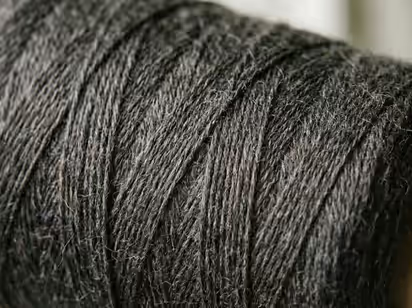
Premium knitwear yarn — certified supply chain, Kiwi Giyim Turkey
Premium yarn cones sourced from OEKO-TEX certified Turkish and Italian spinners

Cashmere Constructions We Produce

01

2-Ply Pure Cashmere

Two strands plied together — the standard construction for fine-gauge cashmere knitwear. Typically run at 12gg or 14gg for a close, lightweight fabric. Appropriate for fitted crewnecks, turtlenecks and cardigans at contemporary luxury retail ($200–$350). Higher fiber cost per unit is the honest reality; MOQ 250 pieces applies at this tier too, but cost per piece is meaningfully above merino equivalents.

02

3-Ply Cashmere (Midweight)

Three plies produce a slightly heavier, more substantial hand — better suited to colder-market positioning and slightly coarser gauges (10gg, 12gg). Reads as warmer and more tactile than 2-ply at the same gauge. Often used for relaxed-fit or oversized silhouettes where a bit of body in the fabric works with the structure.

03

Cashmere-Merino Blend (80/20, 50/50)

Blending extra-fine merino with cashmere improves durability (cashmere alone pills faster than blended yarns) and reduces material cost while preserving the soft hand. An 80/20 cashmere-merino blend is a common entry point for brands that want a cashmere story without full cashmere cost. The 50/50 reads closer to merino but with a noticeably softer finish. Both are honest to label under US FTC fiber rules — the blend ratio must appear on the care label.

04

Cashmere-Silk Blend

Silk adds luster, drape and a slight sheen that reads as elevated even at fine gauge. Typically 70/30 or 85/15 cashmere-silk. The blend changes the knit behavior — silk reduces elasticity and stretch recovery, so gauge selection and stitch structure need to account for it. Best suited to drapey silhouettes (longline cardigan, relaxed pullover) rather than structured fitted pieces.
Fiber Sourcing and Traceability

We source cashmere yarn from spinners who document origin — Mongolian and Inner Mongolian fiber, processed outside Xinjiang. UFLPA compliance is a practical requirement for any cashmere entering the US, and we can provide mill certificates and origin documentation on request. GRS (Global Recycled Standard) and RCS (Recycled Claim Standard) certified cashmere yarn — produced from post-consumer cashmere fiber — is available for brands with a sustainability positioning; lead time and MOQ may differ slightly for specialty yarn programs.

Gauge and Construction Options

Fine-gauge cashmere (14gg) produces the closest, most refined fabric — appropriate for positioned luxury at $250+ retail. 12gg is the most common production gauge for contemporary cashmere, offering a good balance of refinement and production speed. 10gg is suitable for midweight, textured or stitch-pattern cashmere where a slight openness in the fabric is intentional. WHOLEGARMENT (Shima Seiki) production eliminates side seams entirely — for cashmere, this is a meaningful finishing upgrade, as the absence of seams removes bulk and improves drape at every wearing.

Who This Suits

A 250-piece cashmere MOQ is realistic for a US contemporary or contemporary-luxury brand with a proven design and a target retail of $200 or above. At this price point, the US customer is paying for fiber and construction quality — and expects to see both. If you're positioning at fast-fashion price points, cashmere manufacturing in Turkey is not the right path; the fiber cost alone makes it incompatible. If you're building a considered product at the right retail tier, the MOQ, lead time (~14–18 days ocean freight to US East Coast after production completes) and quality calibration work in your favor.

Related Reading

Cashmere & Merino Blend Knitwear OEM

How cashmere-merino blends balance luxury hand-feel with durability — and the gauge options we produce from 7gg to 14gg.

Knitwear Gauge Guide

Which gauge suits cashmere sweaters — and how gauge affects the drape, weight and price point of a fine-knit program.

Yarn Count & Ply for Knitwear Buyers

What "2/28 Nm 100% cashmere" means — and why specifying count and ply is the difference between consistent samples and sample chaos.

Luxury Knitwear

Luxury Knitwear Manufacturing for US Brands

Cashmere, merino and cashmere-blend production for US premium and contemporary brands.

See luxury knitwear →

Developing a cashmere program?

Share your tech pack or design direction and we'll advise on construction, gauge and fiber options — and quote transparently including material cost breakdown.

Related Guides

→ Cable Knit Sweater Manufacturing for US Brands → Chunky Knit Sweater Manufacturing for US Brands → Cardigan Manufacturing for US Private Label Brands
WhatsApp